
The broader NSE Nifty fell 78.75 points, or 0.70 per cent, to close at 11,234.55.

Revenue of the Kolkata-headquartered firm from its cigarettes business climbed 18.76 per cent.

Even as raw material prices start cooling off from their peaks, fast-moving consumer goods (FMCG) companies' margins are expected to remain under pressure at least in the next quarter. This is because commodity prices continue to remain high year-on-year (YoY). Consumer companies will also continue to increase rates as they have been taking price hikes in a staggered manner. They have not yet passed the entire price increase of raw materials to consumers.

'Q1 is going to bear the brunt of the second wave, exposing full-year GDP forecasts to downward revisions, unless phase-3 of vaccination is executed quickly.'

"It went up to 20-odd per cent in 2019 and to 25 per cent a year later. "That's when we decided to pull the plug; it was not sustainable for our business," says Chadha. Madison & Pike, instead, turned to Mumbai-based start-up Thrive, which provides third-party delivery services to restaurants at a much lower commission - three to five per cent.

After a sharp correction over the last few months, analysts seem to be turning cautiously optimistic on the information technology (IT) sector and suggest there could be trading opportunities in select counters despite revenue and growth concerns that still plague the sector. "IT stocks valuations have corrected 17 per cent-49 per cent and stock prices have corrected 9 - 42 per cent since mid-December 2021. Nifty IT index valuation has corrected by 27 per cent and price by 21 per cent. "About two quarters ago, we made a case that valuation drivers have peaked.

Tech Mahindra was the top gainer in the Sensex pack, jumping over 5 per cent, followed by Bajaj Finance, Bharti Airtel, Bajaj Finserv, L&T, Tata Steel and Infosys. NSE Nifty surged 191.95 points to 15,824.05.

'... as has been happening in the last three weeks, then the foreign exchange reserves will not be comfortable to ensure that the rupee does not fall drastically.'

The duo bought additional shares in pharmaceutical companies Lupin and Jubilant Life Sciences, along with Agro Tech Foods and NCC during Q2FY21

Bulls might be on the rampage on Dalal Street but lofty valuations of the Indian equities present a reason for concern and the markets could perhaps witness up to 10 per cent correction, according to analysts. Benchmark indices have been on a record-breaking rally lately and August witnessed the stock market reaching many new highs. The BSE benchmark soared over 9 per cent last month.

While Mukesh Ambani-led RIL posted a 108 per cent YoY rise in profit after tax for Q4FY21 at Rs 13,227 crore, it fell short of Bloomberg estimate of Rs 13,704 crore.

Ajit Mishra will answer Your Questions on the stock markets on a weekly basis. Please mail your questions to getahead@rediff.co.in with the subject line 'Stock Market Query' along with your name and Ajit will offer his unbiased views.
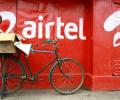
Telecom operator Bharti Airtel will start rolling out 5G services this month and cover all towns and key rural areas of the country by March 2024, a senior company official said on Tuesday. Bharti Airtel managing director and CEO Gopal Vittal also said that the price of mobile services in India is very low and needs to go up. "We intend to launch 5G starting August and extend to a Pan India roll out very soon.

However, despite Covid, Indian markets registered their best financial year performance in a decade, with the Sensex and Nifty50 rallying 68 per cent and 71 per cent, respectively, in FY21.

TCS emerges as a safe haven, as Infosys stumbles for sixth straight quarter.

Equity indices gave up early gains to close in the red for the third session on the trot on Wednesday, weighed by selling in banking and finance counters amid inflationary pressures and persistent foreign fund outflows. A weak rupee and lacklustre global cues also kept buying sentiment in check, traders said. The 30-share BSE Sensex opened on a firm footing but failed to hold on the momentum, finishing 237.44 points or 0.41 per cent lower at 58,338.93. On similar lines, the broader NSE Nifty dipped 54.65 points or 0.31 per cent to close at 17,475.65.

ICICI Bank was the top loser along with index heavyweights RIL, ITC and HDFC.

The companies' combined net profit declined by 10.1 per cent y-o-y during June '19 quarter against 26.2 per cent y-o-y growth a year ago.

Profits grow, but not because of recovering demand.

Sun Pharma was the best gainer among Sensex components, surging 6.91 per cent

Sensex gained nearly 0.4% or 96 points at 26087 level while Nifty ended up by 42 points or 0.5% at 7,791.40 level.

'At this moment, investors should look for relative value within sectors and clear visibility (third-wave-or-not) on earnings delivery.'

SpiceJet, India's second-largest private airline, kicked off the process of hiving off its logistics business to its subsidiary SpiceXpress as it looks to raise much-needed capital. On Tuesday, the company sought its shareholders' approval to complete the process and to raise up to Rs 2,500 crore via a qualified institutions placement (QIP). It is in talks with multiple private equity investors as it tries to sell shares in the logistics arm to raise money.

Sharma would be 60 in November 2018, and would have completed 10 years as Axis Bank's CEO the following year in June.
Shares of HCL Tech hit a fresh record high of Rs 1,118.55 on Friday, up 2 per cent on the BSE in intra-day trade, surpassing its previous high of Rs 1,101 touched on Thursday in intra-day deals.

So far this month, another $4.5 billion (Rs 33,000 crore) has flown into domestic stocks.

Auto-debit payment bounces have gone up for the second consecutive month in May, emphasising the stress building up due to a halt in economic activities as authorities lock down various parts of the country to stop the spread of the virus in the second wave. According to the National Automated Clearing House (NACH) data, in May, of the 85.7 million transactions initiated, 35.91 per cent, or 30.8 million transactions, failed.

Unless these companies falter on growth or external and domestic factors play spoilsport, analysts expect them to do well

'Slower-than-anticipated recovery can be a bigger risk this time than a liquidity-driven event -- at least for India.'
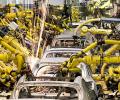
The sharp increase in commodity prices on account of the Russia-Ukraine war has put automakers in a fix. After the frequent price hikes in the current fiscal, manufacturers fear that any more price increases may further dent the already weak demand in certain segments. "We have taken several hikes and cannot immediately do it again. "We will have to closely watch the situation and act accordingly," said an official at an auto firm, declining to be identified. Even for companies like Tata Motors Passenger Vehicles, which has had a strong volume run and a robust order book, passing on the entire costs has been tough.

A look at six indicators shows all of them have collapsed from positive growth in April to contraction in September.

The Indian FMCG industry has recorded a 9.4 per cent growth in the January-March quarter of 2021, helped by a consumption-led growth and value growth by increased prices of products, especially of staples, said data analytics firm Nielsen. The rural market continued to perform with strong growth of 14.6 per cent during the period and the metro markets have registered a positive growth after two quarters. Fast Moving Consumer Goods (FMCG) industry sales growth from the traditional trade channels jumped to double digits, while growth in e-commerce normalised down to single digits in the January-March quarter.

Tata Motors has halved the volume outlook for its UK subsidiary Jaguar Land Rover Automotive (JLR) and warned of lower earnings as it sees the semiconductor shortage deepening in the September quarter of the current financial year, according to a notification issued by the company to the stock exchanges on Tuesday. The announcement caught investors unawares. They were hoping for a quicker recovery. Tata Motors' stock tanked 13 per cent (on July 6) from the day's high of Rs 358.10 and hit the lower circuit (Rs 311.45) in intra-day trades.

After a very weak December quarter and a poor year-to-date fiscal year volumes-when sales plunged to the lowest in nine years, the signs in the first 15 days of January haven't been encouraging either. "Though the severity of the current wave is not as high as the previous one, it has hit the sentiments hard impacting conversion of enquiries into sales," said Vinkesh Gulati, president, Federation of Automobile Dealers Association (FADA).

Bank shares were the top losers along with index heavyweight RIL

CRAs are getting more business than they were getting a year ago. This could indicate expectations that investment demand will rise in the mid-term, says Devangshu Datta.

Infosys, however, cut 2017-18 revenue growth guidance to 5.5-6.5 per cent from 6.5-8.5 per cent in constant currency.

Top losers in the Sensex pack on Friday included Bajaj Finance, ONGC, IndusInd Bank, PowerGrid, L&T, Axis Bank, NTPC, Bharti Airtel, HDFC, HDFC Bank and Kotak Mahindra Bank, falling up to 2.08 per cent.
Consolidated revenue rose to a record Rs 163,854 crore.
Earnings growth has been surprising and there are some signs of overheating in the markets
